Discover and live your purpose in life through your lay vocation!
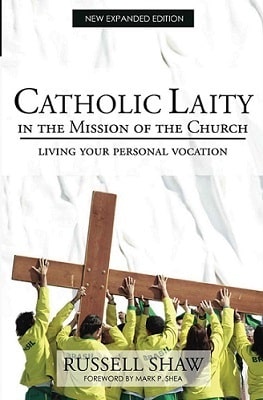
The Church’s mission is to proclaim the Gospel of Jesus Christ to everyone. As lay disciples of the Savior, our shared mission is to bring the message of His saving life, death and resurrection to all men and women through our words and deeds. Your personal lay vocation is even more focused: God has created you for a unique purpose only you can accomplish for Him! As you read this book you will discover the intensely interesting history and theology of the lay vocation and how our Church’s reemphasis on the role of the laity in our day is meant to help awaken this “sleeping giant.” But this is not simply a book of history and theology—it’s about your mission in life and your eternal destiny. Russell Shaw’s insightful work makes a direct connection between the teachings of the Bible, Vatican II, John Paul II, Benedict XVI, and Francis I and your everyday life as a lay follower of Jesus. Here you will learn how to begin discerning your unique personal lay vocation and how to establish, deepen and maintain your friendship with Jesus while you live out your lay vocation in the “real world.”
Jesus told us: I have come that they might have life, and have it more abundantly.” Read this book and find that life through your lay vocation!
A new expanded edition: the complete original 2005 text, plus a new Foreword by Mark P. Shea and a new Preface by the Author.
What others are saying about Catholic Laity in the Mission of the Church:
Russell Shaw is not only the foremost Catholic journalist of his generation, he is also more than an amateur theologian. His insights in his new book help the reader not only to understand the role of “Catholic Laity in the Mission of the Church” but also the role of the laity in evangelizing the culture. Shaw has uncovered for all to see the central message of the Second Vatican Council was radically misunderstood since 1965, i.e. the universal call to holiness. Flowing from understanding that key teaching, Shaw underlines that God has a particular calling or vocation for each one of us: lay, religious, or priest, married or single, and the meaning of our family life, work, friendships, and involvement in the secular world all depends on the proper discernment of our personal vocation through prayer and the sacramental life, and proper spiritual guidance. Only in that way can we begin to carry out the late John Paul the Second’s call for a “New Evangelization” in our country.
—Fr. C.J. McCloskey III is a research fellow at the Faith and Reason Institute based in Washington D.C.
The reality of Catholic teaching is and always has been that, at the altar, the priest presides, but in the world, the layperson presides. God has called each and every baptized person to a work of love as prophet, priest and king. As many of us laity waste time and energy making a lunge for the altar, we are forgetting our true dignity and thereby missing the call and the gifts the Spirit has given us to carry out our God-given vocations to win the world for Jesus Christ. Russell Shaw shows us how to recover our sanity and live out the awesome vocation of the lay saint that the world so desperately needs.
—Mark P. Shea, Senior Content Editor, Catholic Exchange
Russell Shaw knows that the task assigned to the Catholic laity at the Second Vatican Council was “the renewal of the temporal order”. Thus the faithful laity need to be looking beyond participation in the new ministries that have proliferated in the post-conciliar era. These are worthy activities but they are not enough. Mr. Shaw understands that every Christian has a vocation, or call from God. The task of all of us is to discern the vocation to which God has called us and then to carry it out.
—Kenneth D. Whitehead, author of One, Holy, Catholic, and Apostolic: The Early Church was the Catholic Church
Russell Shaw knows whereof he speaks. As a Catholic layman he has served the Church for decades as a spokesman and journalist. He brings to his topic the wisdom that only scholarship can provide and the prudential judgment that rests on years of experience and thoughtful reflection. One may approach this book as one might read a papal encyclical or as a manual to be placed in the hands of the young who ponder their future. Its quiet magisterial tone has the mark of a classic.
—Jude P. Dougherty, Dean Emeritus, School of Philosophy, Catholic University of America